Breaking
Loading...
Showing posts with label School Age. Show all posts

Borax Crystal Snowy Snowman | Winter Science Craft

This week I outdid myself. I did a science craft that is adorable and perfect for winter. Dear Reader, please meet Erwin, my beautiful borax crystal snowman. Please take special notice of his acorn hat.
Borax Crystal Snowy Snowman | Winter Science Craft
Last month we made a whole bunch of borax crystal Christmas tree ornaments and gave some of them away as Christmas gifts. I love crystallizing stuff. It's gotten to the point now where everyone knows the signs. I pick up some random object. I get a goofy look on my face. I start boiling water and searching for the yarn. I'm officially addicted. I need a twelve-step program to end the pattern. "Hi, I'm Crystal. You probably guessed from my name that I like to make crystals. Please help me before I crystallize my neighbor's cat!" (That's right, Bernie, I'm comin' for ya.)

I'm just kidding, I'm not actually going to crystallize Bernie. But, for the record, he would look UH-mazing.

I am thrilled with how this project worked out. I'm not usually very crafty. I can count on one hand the number of times I have used a hot glue gun in my entire life. But one day I had an idea, nay, even a vision, of this cute little snowman I wanted to build. I imagined how the crystals would give him a glittery snow-dusted look. Guys, I have fallen in love all over again. With Erwin. He's adorable.
Borax Crystal Snowy Snowman | Winter Science Craft
Total Time: About 20-30 minutes to assemble your snowman and get the borax solution set up. Then several hours to wait for the crystals to grow.

Safety Concerns: You will need to use a hot glue gun and boil water for this. Just watch the kiddos!

Materials You Need:

To Assemble the Snowman:
Pom poms of various sizes
Pipe cleaners (aka chenille stems)
Googly eyes
Various beads and yarn pieces, depending on how you want to adorn your snowman
An acorn top to use as a hat
Acrylic paint
Mod Podge
Hot glue gun

To Crystallize:
String
Pencil
Mug, vase, or jar
Boiling Water
Borax

Directions:

Assemble the Snowman:
  • Paint the acorn top with acrylic paint. When dry, seal with Mod Podge. Set aside and let dry.
  • Use hot glue to assemble your snowman. Be creative! Stick the pom poms together first. Then glue on the eyes, nose, mouth, etc. I cut a pipe cleaner into smaller pieces and glued them to the sides for arms.
  • Lastly, glue on the acorn hat. Be generous on the glue on this one.
  • Tie a string to the top of the acorn top and hot glue it so it's good and secure.
Borax Crystal Snowy Snowman | Winter Science Craft
To Crystallize:
  • Attach the string to a pencil, pen, spoon, or other long object.
  • Fill your jar or vase with boiling water. Add 3 TBSP borax per cup of water and stir. It's okay if some borax settles on the bottom of your container.
  • Lower your snowman into the hot water/borax mixture. Make sure it is not touching the sides or the bottom of your container, and that you can get it through the mouth of your container easily. Feel free to trim or bend your snowman accordingly.
Borax Crystal Snowy Snowman | Winter Science Craft
  • Make sure your jar is in a quiet place where it won't be disturbed. You don't want it to get jostled or bumped at all while the crystals are growing.
  • After a couple of hours you will start to see crystals growing! Leave your mixture overnight for best results, or remove your snowman after just a few hours if you just want a light dusting of crystals.
  • Let your snowman dry on a paper towel for an hour or so. Then pick it up and admire it in the sunlight. Grab your magnifying glass to get a closer look at your crystals!
  • Name your snowman. Display him proudly. Take a picture and post it on the Science Kiddo Facebook page for us all to enjoy!
Print These Instructions
Borax Crystal Snowy Snowman | Winter Science Craft
The word crystal actually refers to any material that is arranged in an ordered form. Some crystals (like borax) are arranged into little cubes. Other crystals (like snowflakes) have six different arms. You can make crystals from many substances including salt, sugar, baking soda, borax, and epsom salt.

More borax dissolves in hot water than in cooler water, which creates a supersaturated solution. This is unstable. As the solution cools down the little borax particles come out of solution and crystallize easily.
Borax Crystal Snowy Snowman | Winter Science Craft
I can't wait to see your snowy snowman and to hear what you name him! Be sure to post a picture on my Facebook page so we can all enjoy your creation :)

So now you have a big box of borax. What else can you do with it? How about making some slime? Or crystallizing more stuff like I've been doing all week? Let me know what you are up to in the comments!

*This post contains affiliate links. Please see our disclosure policy.


powered by TinyLetter
This post is part of the A-Z STEM Series. Every day during the month of January we will be bringing you tons of awesome science, technology, engineering, and math activities to do with your kids! By the end of the month you'll have over 50 STEM activities to keep your kids busy learning.
A-Z STEM Series | Borax Crystal Snowy Snowman | Winter Science Craft

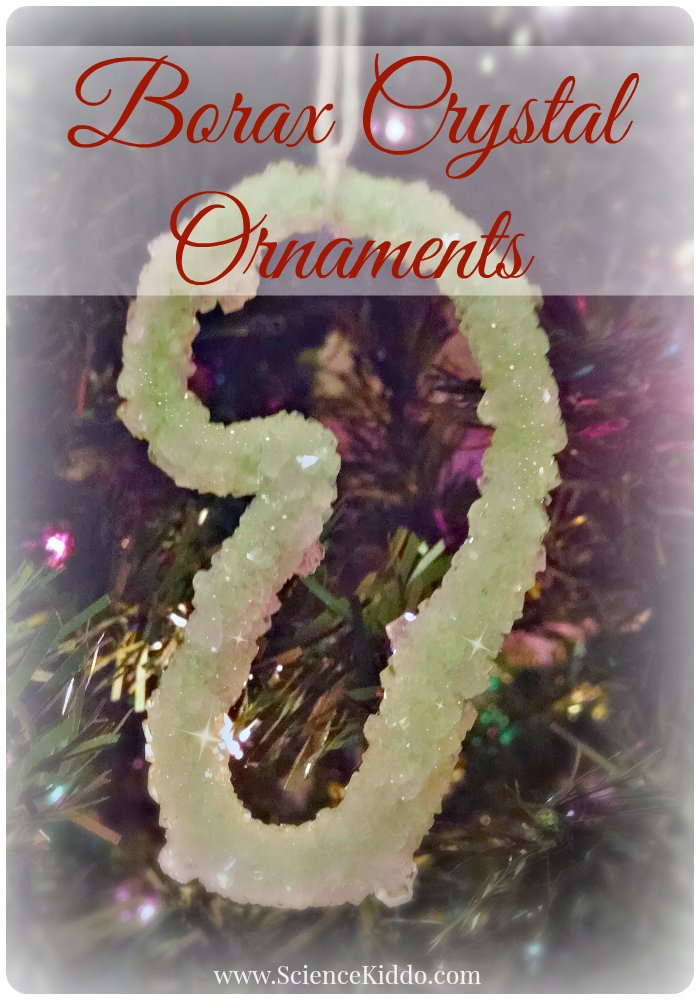
Borax Crystal Ornaments | Christmas Science

I love growing crystals. Makes sense, right? My name is Crystal. Perhaps this is why I have always been drawn to chemistry. But really, if you haven't grown crystals before you need to do it today. The results are completely awe-inspiring and gorgeous, and it's a really easy process. I have gone a bit loco crazy growing crystals since we did this science activity, as you'll see in my posts in the coming weeks. For today, we made our own crystallized borax Christmas tree ornaments and, I have to tell you, they are stunning.
Borax Crystal Ornaments | Christmas Science | Star
Total Time: About 20 minutes to prepare and then several hours to wait for the crystals to form.

Safety Concerns: You will need to boil water for this. Just watch the kiddos!

Materials You Need:
Pipe Cleaners
Festive Cookie Cutters
String
Pencil
Mug, vase, or jar
Boiling Water
Borax

Directions:
    • Bend your pipe cleaner into your desired shape. We did this by using cookie cutters as a guide as seen below.
    Borax Crystal Ornaments | Christmas Science
    • Tie a piece of string to your pipe cleaner shape. You can use string, yarn, or even dental floss if you want!
    • Attach the string to a pencil, pen, spoon, or other long object and set aside.
    • Fill your jar or vase with boiling water. Add 3 TBSP borax per cup of water and stir. It's okay if some borax settles on the bottom of your container.
    • Lower your pipe cleaner shape into the hot water/borax mixture. Make sure it is not touching the sides or the bottom of your container, and that you can get it through the mouth of your container easily. Feel free to trim or bend your shape accordingly. It is fine to have two ornaments in one large container just as long as they don't touch.
    Borax Crystal Ornaments | Christmas Science
    Borax Crystal Ornaments | Christmas Science
    • Make sure your jar is in a quiet place where it won't be disturbed. You don't want it to get jostled or bumped at all while the crystals are growing.
    • After a couple of hours you will start to see crystals growing! Leave your mixture overnight for best results, or remove your ornaments after just a few hours if you just want a light dusting of crystals.
    • Let your ornament dry on a paper towel for an hour or so. Then pick it up and admire it in the sunlight. Seriously, the crystals are intricate and gorgeous. You will want to grab a magnifying glass to observe them more closely!
    Print These Instructions

    The thing I was most surprised at is how sturdy these are! I thought they would be delicate and fragile, but they are deceptively hardy. Also, they look edible, but they aren't. I even found myself tempted to gnaw on them. Don't do it.
    Borax Crystal Ornaments | Christmas Science
    Crystal science is amazing. The word crystal actually refers to any material that is arranged in an ordered form. Some crystals (like borax) are arranged into little cubes. Other crystals (like snowflakes) have six different arms. You can grow crystals from many substances including salt, sugar, epsom salt, baking soda, and borax. In most of my undergrad chemistry labs the last step was to crystallize the product so we could weigh it. I'll tell you, though, these borax crystals are much easier to grow than most of the substances we had to grow in my lab, and they are more beautiful, too!
    Borax Crystal Ornaments | Christmas Science
    I love the way these ornaments reflect the light on our tree. The crystals give the shapes a delicate frosty look.
    And, yes, I know we have a very obviously fake Christmas tree. And, yes, I know this ought to get me kicked out of Portland and banned from ever returning. But it's still kinda pretty, right? RIGHT?!

    So now you have a big box of borax. What else can you do with it? How about making some slime? Or crystallizing more stuff like I've been doing all week? Let me know what you are up to in the comments!

    *This post contains affiliate links. Please see our disclosure policy. 


    powered by TinyLetter
    Borax Crystal Ornaments | Christmas Science

    DIY Window Gel Clings | Christmas/Winter

    Welcome to another edition of Make Your Own Window Gel Clings! Today we are featuring Christmas and winter themed gel clings...ya know, snowmen, bells, candy canes, and stars. I can honestly say that these are my favorite window jellies we have made so far. The key? Glitter. Lots of it.

    It is becoming a bit of a tradition in our household to make new gel clings for each season/holiday. We started with our spring/summer clings, which were replaced by our Halloween bats and pumpkins. Embarrassingly, those stayed up until November 29 when I finally deemed it appropriate to put up Christmas decorations. The Christmas edition may stay put until Spring. We'll see...

    Making your own window gel clings is super-easy. They are even edible if you leave the glitter out. (But really, a small case of glitter-tummy never hurt anyone, right?)

    Grab your favorite Christmas/winter cookie cutters and let's get started!
    DIY Window Gel Clings | Christmas/Winter
    Total Time: About 10 minutes to prepare, 20 minutes to color, 10 minutes to cut out with some waiting time between each step

    Safety Concerns: You will need to boil water for this. Just watch your kids around hot water and the resulting hot gelatin. Let it cool a bit before your kids get close.

    Materials You Need:
    Four cups of boiling water
    Six packets of unflavored gelatin (or about 43 grams)
    Food coloring and glitter of your choice
    Toothpick for stirring
    One large cookie sheet with a rim or two 9 x 13 casserole dishes
    Cookie cutters
    Spatula
    DIY Window Gel Clings | Christmas/Winter
    Directions:
    • Add gelatin to hot water. Stir to make sure it all dissolves and spoon out any bubbles.
    • Pour your mixture into you cookie sheet or casserole dishes. You want it to be about half an inch thick. It doesn't have to be exact, but you want it to be level.
    • Once gelatin is cooled a bit (10-15 minutes), have fun dropping food coloring into your gel and swirling it around with your toothpick. Sprinkle it with glitter if you desire. You only have about 30 minutes before the gelatin starts to harden so don't dawdle!
    • Let the gelatin harden. It should only take 30-60 minutes, but you can leave it out overnight if you desire. Since it's super-concentrated it hardens quickly without being in the refrigerator. We usually leave our gelatin overnight and cut it out in the morning because it seems to stay together a bit better that way.
    • Once it has set use cookie cutters to cut out shapes or cut out your own shapes using a butter knife.
    • Use a spatula to lift your gel shapes out of the pan. Don't worry if they tear because you can simply mold them back together on the window. Stick them to your windows and enjoy!
    DIY Window Gel Clings | Christmas/Winter
    *Please Note: I have had some readers say their gel clings were too wet or heavy and didn't stick to the window. If this happens to you, simply leave your pan of gelatin out uncovered overnight and try again in the morning. If they are still too heavy, leave them again until the next day. Each day, water evaporates out of the gelatin, making it stickier and lighter, thus more likely to stick to your window! Also, they stick better to cold windows than to hot ones, so you may have more success putting them up in the morning when the windows are the coldest.

    Print These Instructions
    DIY Window Gel Clings | Christmas/Winter
    I love how these window jellies catch the rare rays of sunshine during the winter. They light up our front room!

    In addition to being a fun art/sensory/family bonding activity, there is great science to be learned as well! You will notice as the gelatin cools down it gets thicker, or more viscous. When the gelatin is hot the food coloring moves easily through it, but as the gelatin cools down and hardens, the food coloring doesn't mix in as well. My kids had so much fun coloring this batch that they had to rush at the end to get in all the colors and glitter before it firmed up completely!

    Also watch as the days go by how the gel clings dry out. They start out squishy and plump, but within a few days they will be paper-thin plastic-y shapes on the window as the water evaporates out of them. My kids touch them every day to see how they are changing.
    DIY Window Gel Clings | Christmas/Winter
    *This project was inspired by The Kitchen Pantry Scientist. Check out her post for more details about the science of density, diffusion, and evaporation!

    **This post contains affiliate links. Please see our disclosure policy.


    powered by TinyLetter

    Spirograph | Math Fun for Kids

    Kids learn by playing. I had a pediatrician turn to my oldest son when he was four and tell him, "Your most important job is to play, OK?" As kids play their brains pick up on patterns and notice inconsistencies. They experiment, hypothesize, test, and retest. Through play, kids learn all kind of stuff without even realizing it! Today I have some suggestions for mesmerizing play that will help your child learn some pretty complicated math while creating beautiful art.
    Math for Kids Spirograph
    The math behind spirograph is elegant enough for a college trigonometry course, so we're not really going to touch on the specifics on this website for kids. (If you want to know the math behind the patterns check it out here.) Suffice it say that the patterns that are created depend on three variables: the radius of the fixed disc, the radius of the revolving disc, and the location of the pen on the moving disc. By manipulating any one of these variables you can get incredible patterns that are varied and beautiful and mind-blowingly complex. I find myself holding my breath until the pattern overlaps and connects the picture perfectly from start to finish.

    You may wonder where the educational value lies in letting your child play with spirograph. Sure, it's fun and it's art, but does it actually teach your child mathematical concepts?

    YES!

    OK, so maybe they won't be writing out formulas, but in playing with spirograph, in experimenting and trying all kinds of crazy combinations of variables, kids develop mathematical and scientific intuition. Kalid Azad from Better Explained wrote an enlightening article on this subject that I highly recommend you read. He said, "Math is about ideas - formulas are just a way to express them. Math becomes difficult and discouraging when we focus on definitions over understanding." If we work on understanding the ideas first, the formulas will more naturally follow.

    Kids draw spirograph patterns because they are fun. In the act of playing and varying which discs they use and seeing which ones produce the illustrations they enjoy, they will notice patterns. Their math intuition gets stronger, providing a solid foundation upon which to learn more and to learn deeply. That's something we all want, right? Right.

    We recently found this free game called Inspirograph where you can draw your own spirograph patterns online. You can even save and print them if you like! I highly recommend playing with it with your kids and letting them create their own beautiful art! Even my two-year-old has figured out how to use this program. She sat at the table for almost an hour one morning creating and recreating beautiful math art. At two years old she is already building her math intuition.

    Do you have a more tactile learner? If you are looking for a paper and pencil set for your kids the original Spirograph Set is really awesome. I also found this fun Spirograph String Art Set that would be a fun gift. I can see my kids making little ornaments and gifts for their friends with that one. If you have a hands-on learner, one of those sets would provide hours of fun, crafting, and learning.

    Have you played with spirograph before? What are your favorite patterns to create?

    *This post contains affiliate links. Please see our disclosure policy.


    powered by TinyLetter

    Why Don't Water and Oil Mix? | Colorful Bombs

    Want an easy science experiment that will keep your preschooler's mind and hands busy for awhile? Well, here it is! I don't know any kid that can resist the fun of food coloring, especially when associated with the word "bomb". This experiment is super easy to execute and opens itself to lots of hands-on freeplay with colors and mixtures, in addition to teaching the kids some really fundamental science concepts.
    Why Don't Water and Oil Mix Science Activity for Kids
    Total Time: 5 minutes to infinity
    Safety Concerns: None. All materials are nontoxic and edible!

    Why Don't Water and Oil Mix Science Activity for Kids
    Materials You Need:
    Clear glass or plastic cup(s), half full of water
    Vegetable oil
    Food coloring

    Directions:
    • Pour enough oil in each glass to make a thin layer of oil on top.
    • Drop 1-5 drops of food coloring in each cup. The food coloring will bead and sit in the oil layer.
    • Wait and watch for a minute or two for the food coloring to drop from the oil layer to the water layer. Bombs away!
    Oil is made up of different chemical bonds than water is, which is why the two don't mix. (Water is polar, oil is nonpolar, in case you wanted to know.) Oil is less dense than water so it floats on top. The food coloring only dissolves in water since it is water-based. When you drop the food coloring into the cup it beads and sits on the oil layer until gravity finally wins and it drops down to the water layer creating the exciting "bomb" effect.
    Why Don't Water and Oil Mix Science Activity for Kids
    Why Don't Water and Oil Mix Science Activity for Kids
    Watch as the color slowly disperses through the water. Molecules are always in motion, which you can see as the color mixes with the water without any outside stirring. Try stirring the mixture and notice what happens. No matter how much the mixture is stirred the oil will always form a layer on top while the colored water remains on the bottom. If your child is like mine they will want to do this experiment over and over again with different colors!
    Why Don't Water and Oil Mix Science Activity for Kids
    One note: Sometimes it takes several minutes for the colors to drop into the water. Some kids are patient and are willing to wait. Some, like my two-year-old, can't wait for longer than a few seconds. Feel free to spin the glass a little bit to get the color to drop a little bit sooner :)

    Want another variation of this experiment? Try our super simple Lava Lamp using these same materials!

    Follow Crystal's board Chemistry for Kids on Pinterest.

    Saturday Science

    Saturday Science
    And now on to our Saturday Science linky party! Check out our wonderful co-hosts and link up your own math and science activities:
    Water Sensory Science Activities for Kids from Little Bins for Little Hands
    How to Make Math Grid Games With Stickers from Stir the Wonder


    powered by TinyLetter

    Candy Cane Play Gel | Winter Sensory Fun

    Winter...Frost outside, fire in the fireplace, soup on the stove, the scents of evergreen and peppermint in the air. We are finding ourselves inside a lot more these days, grateful to be cozy and warm together. Now that it is chilly and wet outside we are finding new festive ways to play and learn inside. Last week I posted a new way to make a fun squishy sensory material called Play Gel. This week I am bringing you a festive candy cane twist on our new favorite scientific sensory material.
    You can make Play Gel using one of two methods. You can either buy it in the form of Insta-Snow Powder or Sodium Polyacrylate and follow the directions on the package or you can grab a clean diaper and follow the directions in my original post. All of these products are made of sodium polyacrylate and you get the same fluffy, white, squishy, beautiful snow-like gel from all of them. Personally, I think it's more fun to rip open a diaper (plus it's less expensive!), but some people find that strange and opt to buy the powder straight.
    We used two Luvs size 6 diapers and it made probably 12 cups of gel. Sodium polyacrylate is so absorbent, you could even add more water than we did. Experiment for yourself to find the consistency you like!
    Once you have your Play Gel made, divide it in half. Add red food coloring to one half and leave the other half white. Drop in 1-2 drops of peppermint extract or essential oil for olfactory sensory fun, add some glitter if desired, and you are ready to go!
    I arranged our Play Gel into red and white stripes so it looked (and smelled!) like a candy cane and added some red and clear jewels from the dollar store. I wish I had a Maple Leaf to set on top for a shout-out to our Canadian readers! Next time :) Then the kids dug in and PLAYED!
    *This post contains affiliate links. Please see our disclosure policy.

    **Play Gel is not edible, so please keep it out of reach of your babes and toddlers. Also, don't wash large amounts of it down the sink. I have a feeling this stuff is really good at clogging drains.


    powered by TinyLetter

    LEGO Math | Place Value

    We love playing with LEGO at our house. My son asks for new LEGO sets for every birthday and Christmas and then builds and rebuilds his creations during quiet time. I have recently harnessed his enthusiasm by using LEGO bricks to teach him everything from math to reading to science.

    Tommy is a very bright five-year-old with math being one of his very strong subjects. However, he was having a difficult time grasping the idea of place value. No matter what I tried to draw for him on paper or explain to him in words, he just couldn't understand what I meant when I said something like, "Eighteen is one ten and eight ones," or, "Twenty-two is two tens and two ones." He just looked at me like I was crazy. It was too abstract. That is, until I pulled out the LEGO bricks and our place value flip chart and showed him. Suddenly the idea of place value became concrete and he understood it perfectly. Now he can add two-digit numbers together with ease after this one simple lesson.
    Lego Math Science Kids
    All you need to do is designate one column as your "10's" and the other column as your "1's". Choose a number on your flip chart and then arrange your LEGO bricks to reflect that number. Easy! Take turns choosing numbers and arranging them with LEGO bricks. Turn it into a game! Have fun with it.
    Lego Math Science Kids
    Lego Math Science Kids
    Looking for more early elementary math ideas? Check this out:
    Follow Crystal's board Math for Kids in Kindergarten, First Grade, and Second Grade on Pinterest.
    *This post contains affiliate links. Please see our disclosure policy.

    Saturday Science

    Saturday Science
    And now on to our Saturday Science linky party! Check out our wonderful co-hosts and link up your own math and science activities:
    Fall Science Experiment for Kids | Pinecones from Lemon Lime Adventures
    Ears and Sound from Suzy Homeschooler
    Animal Trackers Club from The Joys of Boys

    powered by TinyLetter


    Candy Math and Science

    Are you drowning in candy like we are? My post today is dedicated to all families everywhere who have way more candy than they know what to do with. I will show you today how to use candy to make your kids smarter. That's right! Use your candy to do math and science. Your kids will love you for it (because CANDY!) and you can rest easy knowing they are using their brains and learning some cool stuff.

    Candy Science

    Frankenworms from The Kitchen Pantry Scientist
    Skittles Candy Science from Coffee Cups and Crayons
    Diet Coke and Mentos Explosion from The Science Kiddo
    Test for Acidity from Play Dr. Mom
    Color Experiments from Crafty Moms Share
    Gummy Bear Science from Frogs, Snails, and Puppy Dog Tails
    Dissolving Gobstoppers from Mama. Papa. Buba.
    Candy Chromatography from Mama Miss
    Sink or Float Candy Science from Reading Confetti
    Floating "M" Experiment from P is for Preschooler
    Pop Rocks Balloons from A Little Pinch of Perfect
    Make an Edible Solar System from School Time Snippets
    Skittles Density Rainbow from Gift of Curiosity
    Balloon Experiments with Candy from Learn Play Imagine
    Balancing with M&M's from Inspiration Laboratories
    Exploding Peep Geysers from Housing a Forest

    Candy Engineering

    Candy Play Dough Structures from Coffee Cups and Crayons
    Building Structures with Candy Pumpkins from Lemon Lime Adventures
    Lego Candy Dispenser from Frugal Fun for Boys
    Build a Candy Catapult from Frugal Fun for Boys

    Candy Math

    Sort by Color from Play Dr. Mom
    Pattern Making and Counting from Amy Pessolano
    Graphing, Patterns, and Addition/Subtraction from Preschool Powol Packets

    Follow Crystal's board Fun in the Kitchen With Kids on Pinterest.

    Saturday Science

    Saturday Science
    And now on to our Saturday Science linky party! Check out our wonderful co-hosts and link up your own math and science activities:
    Weighing Activity | Hands-On Math Play from Little Bins for Little Hands
    Top 10 Candy Experiments for Kids from Lemon Lime Adventures
    The Science Behind Cranberries from Stir the Wonder

    powered by TinyLetter


    Child Led Learning | Magnets and Math Facts

    One of the things that thrills me most as a mom is letting the kids lead me in their learning. Often I start doing an activity and Tommy looks at me with wide beautiful blue eyes and says, "Mom, I have an idea!" That's when I know the activity is going to be awesome.
    Letting a child take the lead in his or her learning gives them ownership. It leads to an incredibly high level of engagement that results more substantial learning. Think back to your own education. How much did you learn when you were forced to do an activity that you weren't interested in? Compare that to how much you learned about hobbies and subjects you were free to explore in any way and at any pace you wanted to? How much more do you learn when you love a subject or you are passionate about it for any reason?

    And so it was with the activity I am sharing with you today. I had in mind one thing, but as we got going Tommy took the reigns and led this activity in a completely new and wonderful way.

    Since Halloween is coming up this week we made it Halloween themed, but it's an easy activity to do under any theme any time of the year.

    We cut out shapes of ghosts, bats, and pumpkins from paper. Then we wrote math problems on the back of each shape. (He wrote half and I wrote half.) He is working on simple addition and subtraction right now, but you could easily adapt this to whatever math your child is learning. You could even write sight words or spelling words if you want it to be a reading activity!
    We then attached a paper clip to each little figure. Tommy chose a magnet from our magnet set and attached it to a "fishing pole", in this case, a rubber mallet, with string. Then we were ready to go a fishin'!
    We took turns catching shapes and then answering the math facts printed on the back. We had a great time together, Tommy especially, since he is the one who made up the game and decided what we were going to do each step of the way. It gave him ownership, expanded his creativity, and kept him completely engaged the entire time.
    What skills did we work on? Well, he practiced fine motor skills by cutting. He wrote numbers and answered math facts. He learned about magnets as we fished. And, most importantly, he used his imagination, improved his leadership skills, and had fun!

    Have you had any positive experiences when your child has led an activity? Please share!

    *This post contains affiliate links. Please see our disclosure policy.

     
    Copyright © 2013. Laisy Daisy Days - All Rights Reserved